The Feed Is Broken. You Just Got Used to It.
Open any news app right now. What do you see? A vertical list of headlines, ranked by an algorithm you did not choose, about topics weighted toward whatever drives the most clicks. Story after story, region after region, all flattened into the same format — a card, a headline, a thumbnail. Scroll. Repeat.
This is not how the world works. The world is not a list. It is a planet — with geography, with regions, with stories happening simultaneously in places that have nothing to do with each other and everything to do with each other. A flood in Bangladesh, an election in Brazil, a tech breakthrough in Japan, a conflict escalation in the Middle East — all happening at the same time, all shaping the world you live in.
The feed cannot show you that. The globe can.
What Happens When You Open a Globe Instead
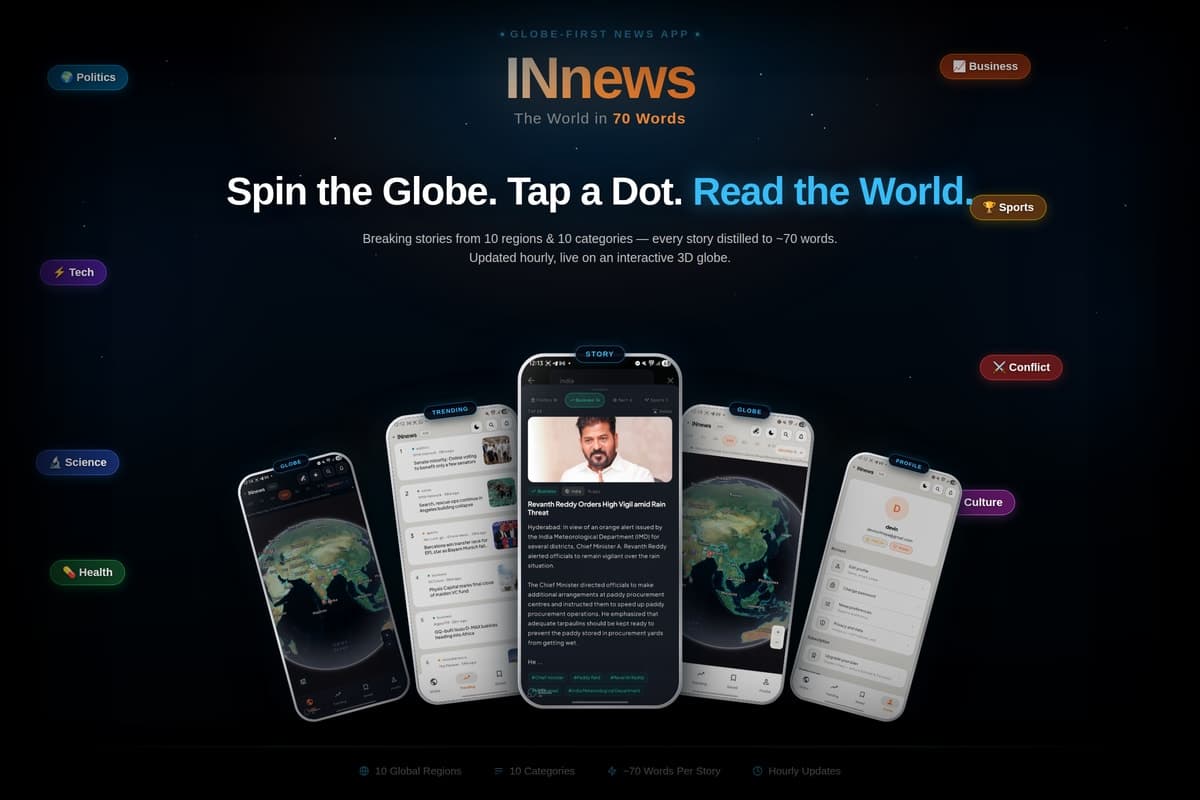
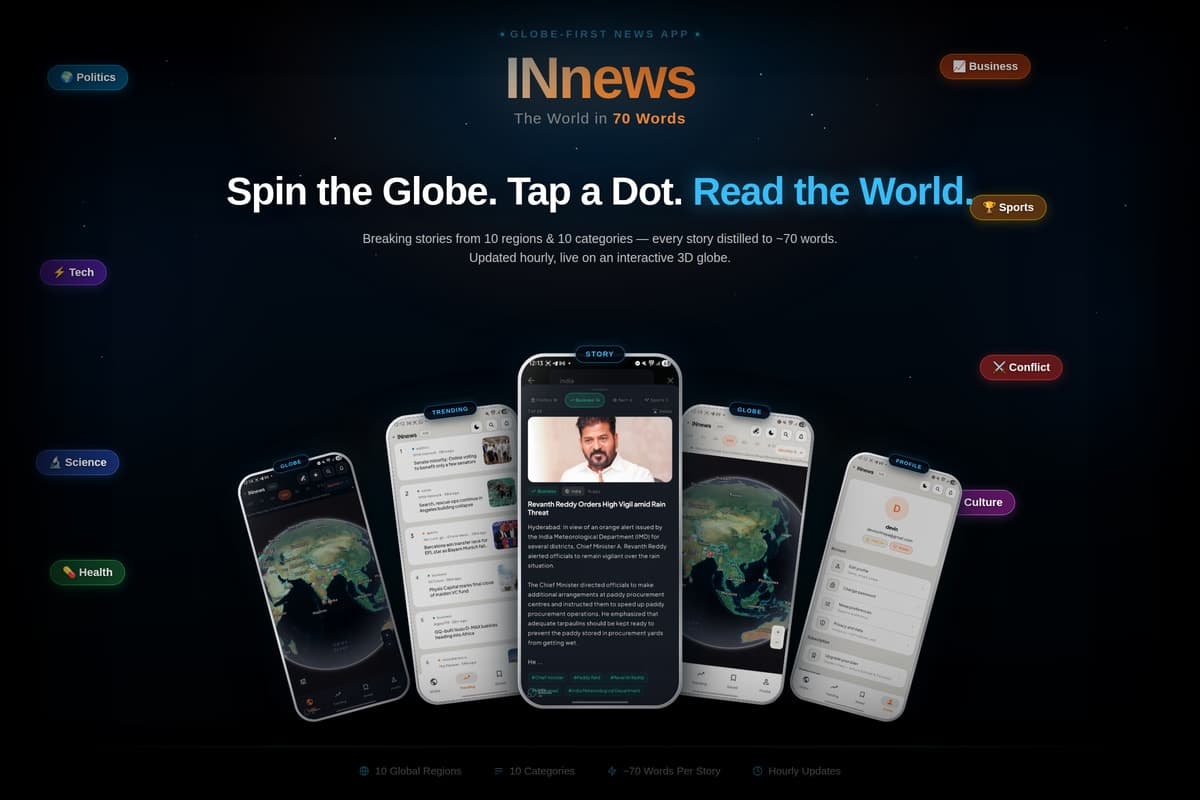
INnews opens to a live 3D globe. Glowing dots appear where news is breaking — right now, plotted by location. You spin the planet. You see where the world is active. You tap a dot and read what is happening there in approximately 70 words.
That experience changes something. Instead of passively receiving a ranked list, you are actively exploring a planet. Instead of reading about "the Middle East" as an abstract concept, you are tapping a dot on the map and reading about a specific city, a specific event, a specific moment. The geography becomes real. The news becomes located.
For anyone who has ever felt overwhelmed by the news — too much of it, too fast, too disconnected — this is a fundamentally different experience. You are in control of what you explore. You choose which region. You choose which category. You read one story, in 70 words, and move on.
Why 70 Words Is Enough
Every story on INnews is distilled to approximately 70 words. This is not a limitation — it is a discipline. It forces every story to answer exactly three questions: what happened, who it involves, and why it matters. Everything else is removed.
Most news articles are not 800 words because the story requires 800 words. They are 800 words because longer articles generate more ad revenue, more scroll time, more engagement signals for the algorithm. The reader's time is not the priority. The platform's metrics are.
70 words flips that entirely. The reader's time is the constraint. The story has to earn its place in under a minute of reading. What remains is the news — clean, factual, and complete enough to understand what is happening.
Readers who switch to INnews consistently report the same thing: they feel more informed, not less, despite reading fewer total words. That is what happens when you remove the noise and keep only the signal.
10 Regions. 10 Categories. One Planet.
INnews covers India, USA, China, Russia and Ukraine, Europe, the Middle East, Japan, Brazil, Australia, and Africa — 10 regions updated every hour from trusted sources. Across those regions, stories are categorised into Politics, Business, Tech, Sports, Science, Conflict, Health, Environment, Entertainment, and Crime.
This is not a firehose. It is a curated window into the parts of the world that matter most to a globally aware reader. You can filter by region if you are following a specific country. You can filter by category if you care about Tech or Health above everything else. Or you can spin the globe and let geography guide you.
For students preparing for competitive examinations, for professionals who need to track global markets, for anyone who wants to be genuinely informed without spending an hour on it — this coverage model is built for the way real people actually want to read news.
The Web App, for When You Do Not Have the Globe
The full 3D globe experience lives in the Android and iOS apps. But INnews also runs as a web app at innews.live — with trending feeds, saved stories, and your account, accessible from any browser without a download. The same 70-word format, the same hourly updates, the same 10 regions — just without the globe spinning beneath your fingers.
It is the same philosophy in a different container. Fast, factual, and built around your time rather than the platform's engagement metrics.
A Different Relationship With the News
The way most people consume news today produces a specific feeling: vague anxiety, a sense of being overwhelmed, and the uncomfortable suspicion that despite reading a lot, you do not actually know very much. The feed optimises for time spent, not understanding gained.
INnews optimises for the opposite. Open it, spin the globe, read five stories in five minutes, and close it knowing exactly what is happening and where. That is the relationship with news that a well-informed person actually needs — not a bottomless scroll, but a clear, located, fast picture of the world.
The future of news is not a longer feed. It is a spinning globe and 70 words at a time.